Qts is one of the most useful Thiele-Small parameters when choosing a loudspeaker driver. It represents the total quality factor, combining electrical damping (Qes) and mechanical damping (Qms) into a single value. Understanding Qts helps you select a suitable enclosure and balance cabinet size, bass extension and efficiency.
This guide focuses on high-power PA bass reflex cabinets, particularly medium-sized, fairly compact enclosures intended to deliver a useful balance of upper and lower bass.
What Exactly Is Qts?
Qts is a dimensionless number describing the total damping of a driver at its free-air resonant frequency, Fs. It is calculated using the following formula:
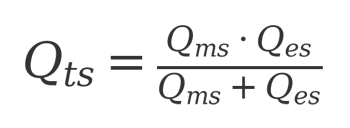
Where:
- Qms = Mechanical quality factor, representing mechanical losses in the driver’s moving system, including the suspension.
- Qes = Electrical quality factor, representing electrical damping associated with the voice coil and magnetic motor system.
Lower Qts means more damping at resonance. Higher Qts means less damping. In most PA bass drivers, Qms is much higher than Qes, so electrical damping has the greater influence and Qts sits close to Qes.
A stronger motor increases electrical damping when the other relevant driver parameters remain the same. However, Qts describes the behaviour of the complete resonant system: it is not simply a measurement of magnet size or motor strength.
The Best Qts Range for PA Speakers
For a medium-sized, fairly compact PA bass reflex cabinet, use the following starting points:
- Qts 0.30–0.45: A useful broad range to investigate for PA bass reflex woofers and subwoofers.
- Qts 0.33–0.40: Our preferred starting range for balancing cabinet size, useful low-bass extension and efficiency.
- Qts around 0.35–0.38: A particularly useful part of that range, represented by many successful general-purpose PA bass drivers.
These ranges are useful when you are faced with a long list of drivers and need a sensible way to narrow the choice. They identify promising candidates before looking more closely at the intended cabinet and the remaining parameters.
How Qts Affects Ported Enclosures
Higher Qts generally favours a larger enclosure for a smooth conventional reflex response, particularly when comparing drivers with similar Vas.
The progression below assumes broadly comparable bass drivers and similar design goals:
| Qts range | Practical effect on bass reflex design |
|---|---|
| Below about 0.33 | Smaller conventional enclosure volumes become practical, with a trade-off in natural low-bass extension or response shape. Useful for compact designs, higher bass cutoffs or planned equalisation. |
| Around 0.33–0.40 | A useful balance of enclosure size and bass extension for general-purpose PA bass reflex cabinets. |
| Around 0.40–0.50 | Larger cabinets become more appropriate for a smooth response. Keeping the enclosure small can produce a more pronounced rise in part of the bass range. |
| Around 0.50 and above | A smooth, extended reflex response can demand a very large enclosure relative to Vas. Compact conventional reflex designs become less straightforward. |
Vas provides the volume context. Two drivers with the same Qts can suit substantially different cabinet sizes because their Vas values differ. Fs also matters: it helps establish the frequency range over which the driver and enclosure will operate.
Higher Qts does not automatically produce deeper bass in the same cabinet. The additional extension associated with a larger-box alignment comes from choosing the appropriate volume and tuning for that driver.
Lower Qts, Compact Cabinets and DSP
Low-Qts drivers have an important role in compact bass reflex systems. Their stronger damping can be used as part of a design that trades an unassisted flat bass response for a smaller enclosure.
The resulting response may slope down towards the lowest bass frequencies. DSP equalisation can lift this region, allowing the driver, cabinet, amplifier and processing to be designed together as a complete system.
This is a useful approach for compact powered PA systems, but the additional bass requires amplifier headroom and places greater demands on the driver and port. High-pass filtering and limiting are part of the design, particularly to control excursion below the cabinet’s tuning frequency.
DSP changes the frequency response. It does not remove the trade-off between small cabinet size, deep bass and efficiency.
What About Horn-Loaded Speakers?
Lower-Qts drivers are also common in horn-loaded PA enclosures. Drivers in the region of 0.15–0.30 are useful candidates to investigate for these applications, where the horn supplies an acoustic load and the rear chamber forms part of the complete design.
Horn suitability also involves Fs, motor strength, moving mass, excursion and the horn geometry. EBP can provide an additional screening tool. A low Qts identifies a direction to investigate; the horn design determines the required combination of parameters.
The same low-Qts driver may also be useful in a compact reflex system with suitable processing. Low Qts is therefore not an instruction to use a horn.
Higher Qts and Other Enclosure Types
As Qts rises, larger reflex enclosures and other enclosure types become more relevant. High-Qts drivers also appear in free-air, infinite-baffle and passive open-baffle applications, which have different design priorities from compact PA bass reflex cabinets.
For the compact PA application covered here, increasing Qts is a reason to examine the required enclosure volume more closely.
Qts, Bass Character and Transient Response
Descriptions such as tight, punchy or deep bass relate to the performance of the complete loudspeaker system. Qts influences the alignment, but the final frequency and transient responses also depend on cabinet volume, port tuning, crossover filters and equalisation.
The practical aim is to match the driver to the required response. A lower Qts is not automatically a better-sounding driver, and a higher Qts does not automatically mean slow or poorly controlled bass.
PA Speaker Examples
These established 18-inch PA drivers illustrate the balanced approach. The figures below refer to their 8-ohm versions:
| Driver | Qts | Fs | Vas |
|---|---|---|---|
| B&C 18TBX100 | 0.35 | 34 Hz | 212 litres |
| Fane Colossus Prime 18XS | 0.385 | 33 Hz | 257 litres |
| Beyma 18LEX1200Fe | 0.38 | 32 Hz | 277 litres |
These drivers share more than a similar Qts. Their combination of Fs, Vas, efficiency and excursion capability makes them useful examples of drivers that balance upper and lower bass in practical PA reflex cabinets.
For a quick illustration of how to interpret Qts:
- Example 1 — Qts 0.35: A strong starting candidate for a medium-sized PA bass reflex cabinet. Check Fs and Vas to establish the likely bass extension and volume requirement.
- Example 2 — Qts 0.42: Still a useful reflex candidate, with the design direction moving towards more enclosure volume for a smooth response when the other parameters are comparable.
- Example 3 — Qts 0.20: A candidate for a suitable horn design or a compact reflex system designed around response shaping. Examine the complete application rather than treating it as a drop-in alternative to a higher-Qts driver.
Final Thoughts
For a medium-sized, fairly compact PA bass reflex cabinet, Qts is a useful first filter:
- Start around Qts 0.33–0.40 for a useful balance of cabinet size, bass extension and efficiency.
- As Qts rises, expect enclosure volume to become more important when aiming for a smooth, extended bass response.
- As Qts falls, consider smaller cabinets and the response trade-off, including whether DSP is part of the intended design.
- Use Vas and Fs to refine the shortlist, then check the driver in the intended cabinet volume and tuning.
This is a rough guide, and exceptions to these rules exist. The ranges describe gradual tendencies, not hard boundaries. Qts alone does not determine enclosure size, efficiency, maximum output or sound quality. Use the complete driver specifications, manufacturer recommendations and enclosure modelling to confirm the final choice.