Author Archive

The Human Ear

Posted By Andy Kos

Something often overlooked, but I believe to be an important part of designing, building and configuring loudspeakers systems is understanding some of the basics of the human ear, and the effects of sound on the human body. This article is intended as a brief introduction, and is by no means exhaustive.

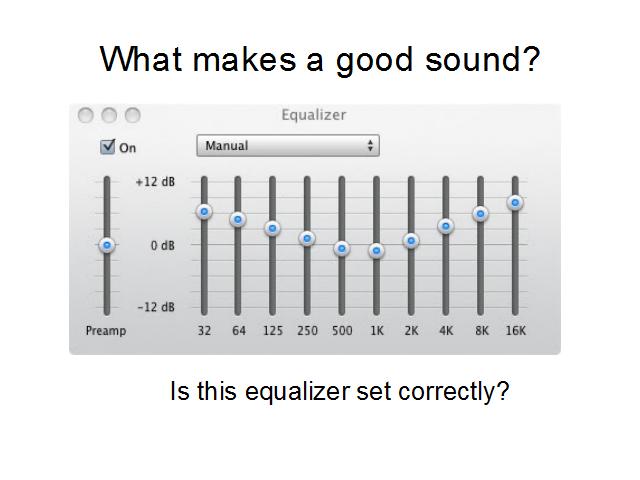
The smiley face equaliser

img1

I’m sure you’ve seen this used, and possibly even done it yourself at some point in time.

Some would argue this is wrong, others that it is right.

The ‘smiley’ face curve often seen on graphic equalisers is similar to the effect achieved by the ‘loudness’ button on many hi-fi systems. It boosts the bass and treble to make it sound ‘better’ – but why do we think it sounds better?

Is it the speakers arent working properly? Maybe… we’ll discuss this later

But is something else wrong?

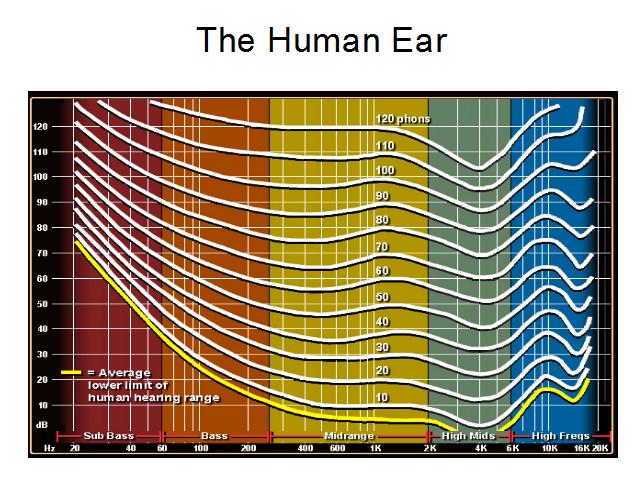
You might assume your ear works like a high quality studio microphone, with a flat frequency response across the audio spectrum, research has shown this is not the case. The way the ear responds to different frequencies varies considerably.

human ear


The graph above shows lines of perceived equal volume. First thing you will notice is that the smiley face equaliser curve is remarkably similar to the frequency response of the ear, but offset a little with the centre point around 3kHz and more emphasis on low frequencies. To some extent the smiley face can be explained as just naturally compensating for the human ear, making lower volume program material sound like we would expect it to sound at high volume.

Key Points:

Essentially deaf to bass frequencies:  This goes some way to explaining the loudness functions on hi-fi systems, at low volume, we find bass very difficult to hear, and it needs boosting significantly. As the volume increases the curve flattens, requiring less bass boost. In effect the loudness function is giving our ears the same balance as ‘loud’ music, but at low volume. Many people are unable to hear detail in bass frequencies, and some actually prefer the sound of distortion in bass frequencies, as they feel the sound is ‘warmer’

Most sensitive to mid-range frequencies peaking at around 3-4 kHz: Approximately the same frequency as a human high pitched scream or yell, which is not dissimilar to a baby’s cry. This means our ears are most efficient at detecting important sounds, research suggests this is down to years of evolution. Many alarm designers utilise these frequencies to maximise effectiveness. With out ears being so sensitive in the mid frequencies, poor quality sound, particularly distortion will be extremely noticeable, perhaps this goes some way to explaining the smiley curve; a way of masking problems in the mid-band by overpowering with bass and treble? Many people find distortion in the upper-mid frequencies painful, and this is often linked with occurrences of tinnitus.

Response varies with volume: As the volume increases, our ears hear differently. This is one of the reason many high-end large scale PA Systems utilise Dynamic EQ, where the equalisers are programmed to change as the volume increases. If you do apply equalisation to your sound system, you may need to adjust it for low/high volume.

So is the smiley curve correct? In my opinion, most of the time it isnt, particularly if you are playing back pre-recorded music the original recording will have been tweaked by the engineer to sound ‘right’. What is definitely correct is to equalise your system to make it sound right at the volume it is being used, and the room it is being used in, and the type of program material being played through it. If this happens to be a smiley curve, so be it, but as a system operator you should resist the urge to just boost bass and treble in the hope it will sound better. If you find you are doing this a lot, you might want to consider upgrading your sound system.


Be the first to comment

Totally Addicted to Bass?!?

Posted By Andy Kos

Its well known that a heavy bass line is in dance music is often very popular, and many people believe it is absolutely essential in order to create the best atmosphere for certain styles of music, but could we actually be addicted? Some people think it may be possible, and there is some research to suggest they are right.

To understand how this may be possible, we need to understand how sound affects our bodies. In modern life, one of our primary needs to hear is to communicate, often at moderate volume, but our ears can be much more useful than this, allowing us to be aware of things further away than we can see, and some of these things may help explain how our bodies react to sound.

Thousands of years before we had amplified music, bass frequencies, and how we reacted them, could have been critical to our survival. In nature, loud sounds, with an emphasis to low frequencies are often connected to danger. Just think of the sounds created by a stampeding herd of animals, an earthquake or a volcano erupting. Research suggests that years of evolution have developed the ‘fight or flight’ response in humans when presented with danger, this stimulates the production of adrenaline, enhancing the bodies ability to react to the danger.

You’ve heard of adrenaline junkies right? Well, it is possible that the brain associates high levels of bass with pleasure due to the mild adrenaline rush that bass frequencies may cause, and over time, coupled with other stimulants, could contribute to an addiction.

Another field of research suggests exposure to very high sound pressure levels (commonly found in bass frequencies) damages our ears and causes ‘pain’, however our bodies naturally react to this pain by creating numerous chemicals within the body, including adrenaline, endorphines and encephalons, collectively acting to blunt pain, but at the same time causing a pleasure enhancing morphine-like effect. This has yet to be proven, but the theories seem to hold true, and could also contribute to this concept.

One researcher has even gone as far as to suggest that extreme bass frequencies that penetrate the human body, causing you to literally ‘feel the bass’ may cause temporary damage to cellular structures within your body, cause the same pain blocking chemicals to be produced. These chemicals make you ‘feel good’ and may go some way to explaining the positive feeling experienced by high intensity bass frequencies.

So, is it possible to be totally addicted to bass?

Maybe….


Be the first to comment

What’s up with the Watts?business path choice
Choosing the right loudspeaker driver can feel like a minefield, especially if you’re new to PA sound. One of the most confusing areas is power ratings, usually quoted in watts.

To make matters worse, advances in materials and testing standards have seen many drivers increase their quoted power ratings by 25% or more, sometimes with no physical changes to the driver at all. Add in terms like RMS, Continuous, Program, and Peak power, and it’s no surprise there’s confusion.
This article mains to explain what those power ratings actually mean, clears up some common myths, and helps you choose sensible amplifier and speaker combinations.

Q: My amp is rated at 400W per channel. Will a 600W driver damage it by drawing too much power?

A: No. An amplifier’s power rating describes the maximum power it can deliver to a speaker before it reaches the limits of its power supply and begins to clip or distort. A loudspeaker’s power rating describes the maximum power it can safely absorb before overheating or failing.

Speakers do not “pull” power from an amplifier. Provided the impedance load is correct, a speaker cannot draw more power than the amplifier is capable of supplying.

Learn more about impedance and why it matters

Q: If I replace my 400W speakers with 450W speakers will they go louder?
A: Not necessarily. The limiting factor is usually the amplifier. If your amp is rated at 400W, you will not get more than 400W of clean output without distortion and potential amplifier damage. If your amplifier can deliver 450W, higher power handling may allow slightly higher output, but it may make no difference at all, and in some cases the speaker may even be quieter.
The key factor is efficiency. Some speakers convert electrical power into sound more effectively than others. If two speakers are operating at the same power level, the more efficient one will be louder. This is normally indicated by the sensitivity rating, measured in dB @ 1W / 1m.
Efficiency and Sensitivity

Q: Which power rating should I look at?

If you’re new to this, the most useful figure is the continuous power rating, usually specified using the AES standard. This gives a sensible indication of how much power a driver can handle of ‘continuous sound’ under realistic conditions and is the figure most manufacturers now quote.

You may also see a program or music power rating, which is typically around twice the AES rating. Peak power ratings are often quoted as four times the continuous rating and are of little practical use. If you see a peak figure, dividing it by four will usually give a reasonable idea of the true continuous power capability.

Q: What do the power ratings mean?

Continuous / “RMS” Power. Historically, loudspeaker power ratings were often quoted using continuous sine-wave tests, sometimes at a single frequency such as 1 kHz. These tests were easy to define and repeat, but they were not representative of real music and placed unusually high thermal stress on the voice coil.

The term “RMS power” is technically incorrect, as power itself does not have an RMS value; RMS applies to voltage or current. The RMS voltage is used in the power calculation, which is where the term originated. While RMS is useful for steady, resistive loads such as heaters or cable thermal calculations, it is not an ideal way to describe how loudspeakers behave with dynamic audio signals.

As a result, RMS power has largely been replaced by standardised noise-based tests that better represent music and broadband programme material, most notably the AES standard.

Over the years, manufacturers have used several recognised standards (a few still reference older ones):

  • IEC 268-5 (1978) – International Electrotechnical Commission
  • EIA RS-426-A (1980) – Electronic Industries Association
  • AES2-1984 – Audio Engineering Society
  • AES2-2012 – now the most widely adopted standard

When many manufacturers moved from the EIA standard to AES testing, some drivers saw power ratings increase by 25% or more without any physical design changes. One example we are aware of is a high-power 18″ driver that was re-rated from 600W to 800W purely as a result of the change in test method.

How is this possible? The AES standard defines a broadband pink noise signal with a specified crest factor for power testing, which differs from older methods. Many manufacturers implement the AES test using controlled noise over a defined period to stress the voice coil thermally, and this often results in higher quoted power figures compared to older standards. While the exact test duration and setup can vary by manufacturer, the AES rating provides a more consistent benchmark for comparing loudspeaker power handling.

Music / Program Power.

Often quoted as Program or Music power, this figure is typically defined as twice the continuous (AES or equivalent) power rating, representing a +3 dB increase. This does not mean the loudspeaker can handle twice the average power. Instead, program power allows for higher short-term peaks while the long-term average power remains the same as the continuous rating. In practical terms, this corresponds to a signal with a higher crest factor than the standard continuous test signal.

Real music contains peaks and valleys rather than a constant energy level. Program power reflects this by permitting greater instantaneous power during musical transients, provided the average power over time does not exceed the continuous rating. For system design, program power is best viewed as a headroom figure rather than a usable continuous operating level. Treating program power as a sustained power rating will almost certainly result in loudspeaker damage, however program power is useful for calculating amplifier power to get sufficient headroom. Opinions vary but most people suggest getting an amplifier slightly larger than AES power is a good start. If you want decent headroom, maybe aim halfway between AES Power and Program power – but at this point you have to start exercising caution with compressors and limiters to ensure the long term power rating does not get too high.

Peak Power:

This is the maximum very short-term power a driver can survive, and is typically quoted as four times the continuous (AES) power rating, representing a +6 dB increase. It exists almost entirely as a theoretical limit and has little relevance to real-world system design.

Peak power should not be used for amplifier matching, system sizing, or safe operating levels. Its primary practical use is for marketing, or for impressing someone who doesn’t know anything about sound.

Should I buy the most powerful speakers I can afford?

Probably not. It’s usually better to choose speakers that are appropriate for your amplifier power and intended use.

High power drivers are typically designed to survive large amounts of electrical and mechanical stress. This often involves design trade-offs such as heavier moving parts, longer voice coils, and suspensions optimised for high excursion. While these features increase power handling, they do not automatically increase efficiency.

As a result, a very high power driver is not necessarily louder at low or moderate power levels than a lower power driver with higher sensitivity. If you compare two extreme examples, such as a 100W driver and a 1000W driver, both driven from a 100W amplifier, the lower power driver may actually produce more output simply because it converts the available power into sound more efficiently.

The higher power driver only begins to show its advantage when sufficient power is available to drive it closer to its intended operating range. With a larger amplifier, it will ultimately produce far more output than the smaller driver ever could. However, when amplifier power is limited, choosing a driver with power handling far in excess of what the amplifier can deliver offers little benefit, and could be detrimental. Typically a 1000W woofer can be heavy and inefficient compared to a 200W woofer. On a smaller amp of 200W, the 200W woofer could actually play louder than the 1000W woofer which is inefficient.

In short, more watts on the specification sheet do not guarantee more sound. Sensitivity and appropriate system matching matter far more than headline power ratings.

So what if I exceed the power ratings?

You run the risk of overheating the voice coil and causing thermal failure. However, staying within the recommended power rating is not a guarantee of reliability.

Loudspeakers can also be damaged mechanically through excessive cone movement. This is described by excursion limits such as Xmax and Xlim. It is entirely possible to destroy a driver through over-excursion without ever exceeding its rated power, particularly at low frequencies or in poorly controlled enclosures.

There is also an important interaction between excursion, bandwidth, and cooling. In some situations a driver can reach its thermal limits at power levels well below its rated AES power.

For example, running a loudspeaker over a very narrow pass band (such as 30–40 Hz) in a cabinet tuned close to that frequency can result in extremely low cone excursion. While this may reduce mechanical stress, it also reduces air movement around the voice coil. Since many drivers rely partly on cone motion to aid cooling, limited excursion can significantly reduce heat dissipation.

In these conditions, particularly in small enclosures with restricted airflow, the usable thermal power handling may be substantially lower than the published AES rating. In extreme cases it can be closer to 50% of the rated value, despite excursion remaining well within safe limits.

What about Power Compression?

Power compression is the hidden problem that can upset even the best-planned systems and make published specifications feel misleading. Many manufacturers choose not to quote power compression figures at all, and some avoid mentioning it entirely.

Loudspeaker sensitivity is specified at 1 W measured at 1 m. At this very low power level, the voice coil remains cool and the driver is highly efficient at converting electrical energy into sound.

In real use, voice coils heat up. Most are wound with copper, which has a positive temperature coefficient of approximately 0.39% per degree Celsius. It is entirely possible for the voice coil of a high-power driver to reach temperatures approaching 200°C, resulting in a resistance increase of 50% or more.

As the voice coil resistance rises, the effective impedance of the driver increases. An 8 Ω loudspeaker may behave more like a 13–14 Ω load at high power. The amplifier delivers less current, acoustic output drops, and a significant proportion of the input power is lost as heat rather than sound.

The practical result is reduced output at high drive levels. A well-designed driver with good thermal management and low power compression can be 3–4 dB louder at full power than an otherwise similar driver that suffers heavily from compression. For this reason, modern high-quality designs place increasing emphasis on cooling and heat dissipation to minimise power compression.
1 Comment. Join the Conversation

Power Compression

Posted By Andy Kos

When selecting speakers, it’s common for people to just look at maximum power handling, and many manufacturers make a point of specifying seemingly unbelievable power handling capacity of 1000W or more. Its quite rare for manufacturers to specify power compression though, and it seems to be often overlooked by system designers.

It seems that loudspeakers to handle what appear to be insanely high levels of power compared to 10 or 15 years ago. Has there been some amazing technological breakthrough? Do we need to re-write the physics text books? No, it’s still just basic physics – so what are the changes?

Firstly, modern materials used in the construction of voice coils are able to withstand significantly higher temperatures before failing.  Why is this important? Well Cone loudspeakers are in fact very inefficient, with even the best transducers only converting around 5% of the electrical energy supplied into sound, the majority of the remainder is converted into heat. So a 1000W bass speaker running at full power may well be converting only 50W into acoustic power, and 950W of heat. Thats like having a 1kw bar heater in your bassbin! That’s a lot of heat, which can cause big problems.

Aside from improving construction materials, manufacturers are also refining designs to maximise heat transfer away from the voice oil, this also contributes to the increases in power handling capacity we are experiencing.

What’s all this got to do with power compression?

Enabling speakers to handle much higher temperatures might seem a good thing, as it increases maximum power handling, but it also has a detrimental effect. Most voice coils are made from copper or aluminium wire, both of which have a positive temperature co-efficient of around 0.4% per °C. What’s the significance of that? You will have heard of superconductors, which operate at extremely low temperatures in order to try to reduce and minimise resistance.  Loudspeaker voice coils  unfortunately work in the opposite way: as the temperature increases, the resistance also increases.

A modern state of the art voice coil is designed to withstand extremely high temperatures, often operating at up to 3000C or more when driven at full power. 0.4% may sound insignificant, but remember this is per °C – at only 2300C the voice coil DC resistance has almost doubled which causes the voice coil impedance to increase accordingly. Some simple maths and you can quickly see that the increase in temperature  can make your 8 ohm speaker start behaving more like a 16 ohm speaker.

So after setting your sound system carefully at the start of the night, an hour in, and it doesn’t sound as loud – you might wonder whats going on. Two things: firstly, your ears have a self defence mechanism: there are 2 tiny muscles in the middle ear that will contract when the ear is exposed to loud sounds. This contraction will reduce the loudness of the sounds reaching the inner ear, thereby protecting the inner ear against exposure to loud noises. This isn’t power compression, but it’s something to be aware of, as you may well be tempted to turn up the volume, I know from experience that a typical DJ will certainly try this, and end up running his mixer into overdrive in the attempt to get more volume.

The second factor is power compression, a typical loudspeaker can lose 3-6 dB of volume once power compression kicks in.

You could think of power compression a bit like the aerodynamics of driving a car. When you start moving, a certain level of power from your engine sets you hurtling forwards at high speed, but as you go faster, wind resistance increases, so you stop accelerating. You need to apply more power to increase speed, but wind resistance keeps increasing too, so you have to apply even more power.

If your amplifiers have headroom, your instincts will make you want to turn them up, to restore the original volume level. To some extent this will work, if you’re familiar with the maths, you’ll see whats going on. Your 8 ohm speaker at room temperature happily accepts 1000W from your amplifier, and gradually reaches an operating temperature of say 250°C. Your resistance has doubled, and your ‘new’ 16 ohm speaker will probably only be receiving around 500W from your amplifier. In a way, as the speaker reaches temperature, it ‘protects itself’ by reducing the power it is operating at, stopping it getting any hotter. If it were to cool a little, the power would increase again, causing it to heat up.

Lets suppose you turn the gain up on your amplifiers, determined to try to push 1000W through your speakers. As you apply more power, you will generate more heat,  perhaps reaching 350°C or more, with your speakers resistance continuing to increase to perhaps 20 or more ohms. Essentially you are fighting a losing battle, as you turn the gain up, the speaker fights back with a higher resistance. You will eventually reach a limit, either your amp will run out of headroom and you cant turn it any louder, or the other possibility, which happens all too often, is your speaker will overheat, and burn out causing catastrophic failure.

Now you know about power compression and the fact that speaker resistance increases with heat, you’ll probably realise that you actually have to push a speaker very hard in order to cause it fail – so if your speaker suddenly fails and you smell burning, the only person to blame is YOU, as you now know better than to try to fight power compression by applying more power.

Now consider what effect power compression will have. 3-6dB loss at full operating power is almost like switching off half your PA system. To achieve the same consistent volume you will need twice as many speakers!

What’s the solution? Either buy speakers with headroom, e.g. if you want to operate at around 500-600W, you might want to consider purchasing speakers rated at 800W or more. At 75% of rated power, the effects of power compression should be much less significant. Also, try to select speakers with improved cooling technology, that suffer less from power compression. Avoiding power compression could make your speakers twice as loud, meaning you could take half as many to the gig!

There are other side effects from the increased levels of heat in a speaker, T/S parameters can vary, bass can sound boomy and mid frequencies can sound muffled. For the best sound quality, its best to try to  minimise power compression effects,


Impedance – FAQs

Posted By Andy Kos

How do I know what impedance load I have?

Most manufacturers will specify impedance, and will include it in the product specifications, often printing it on the speaker itself. If you don’t have this information, you can measure the DC resistance using a multi-meter (please note Resistance is NOT Impedance – find out why here: https://speakerwizard.co.uk/impedance-and-resistance-whats-the-difference/

You should only measure the resistance of speakers when they are not in use, and not connected to an amplifier. By putting your multi-meter probes on each terminal of the speaker you will get the DC resistance, which can be used as a guide to get the impedance. A DC resistance of 5-6 ohms is normal for a driver with 8 ohm impedance, around  12-13 ohms  is common for  a 16 ohm impedance driver, and  3 ohms DC resistance would be normal for a 4 ohm impedance. You may notice that moving the cone whilst checking the resistance will make the reading change, this is because the voice coil is moving in a magnetic field, which will induce a voltage in the  coil, which in turn will affect the multimeter’s measurement.

Many loudspeaker manufacturers will label the drivers to make identification easier, Eminence for example include a suffix on the drivers, for example the Beta12A is the standard model, and is 8 ohm impedance, the letter A designated 8 ohm impedance. The Beta 12B is 16 ohm impedance, and the Beta 12C is 4 ohm impedance. This same letter designation is used through the range of Eminence speakers.

I have more than one speaker in parallel – what’s the impedance?

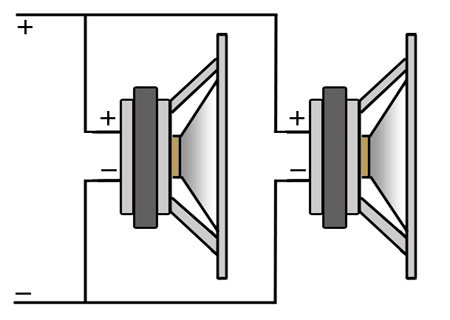
First, let’s clarify what we mean by parallel, this is where the electrical paths through the drivers from + to – run in parallel to each other. If you trace a route from + to – you go through either one driver, or the other. The diagram below shows two speakers wired in parallel:

parallel

 To wire speakers in parallel, all you have to do is connect the + (positive or red terminal) on each speaker to the + (positive or red terminal) on your amplifier, and the corresponding – (minus or black terminal) on the speaker to the – (minus or black terminal) on your amplifier. If you plug several speakers into one amplifier, unless you have unusual cabling, this would be the standard way you would run several speakers off one amplifier.

Its normal to put speakers of the same impedance in parallel with each other, mismatching impedances isn’t a great idea unless you have a fairly advanced knowledge of speaker systems and are doing this for a specific purpose.

So what does this do to the impedance?

The impedance of each speaker stays the same, but the impedance load the amplifier sees will change. In the diagram above, if the two speakers were both 8 ohm impedance, the load the amplifier would see is 4 ohms. To think of this in simple terms, you could think of one loudspeaker as a busy road with a specific amount of traffic travelling along it, if you have two roads, the traffic can travel along either road, which presents less ‘resistance’ to the same amount of traffic. With a basic knowledge of maths, and using this analogy of two routes between start and finish, you can guess what the resistance of two parallel 8 ohm drivers would be, it’s half that of one 8 ohm driver, and is 4 ohms.

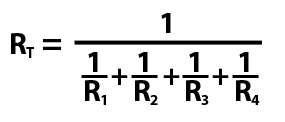
The formula for calculating parallel resistances is as follows:

parallel_formula_web

R1, R2, R3, are the individual resistances, the formula works for as many, or as few resistances there are in parallel, for two drivers in parallel, you use R1 and R2 only, for three drivers you use R1, R2 and R3.

RT is the total parallel resistance. For equal parallel resistances, the formula becomes very simple, as the table of parallel 8 ohm impedances shows:

No drivers Parallel Impedance Fraction
1 8 ohms 1/1
2 4 ohms 1/2
3 2.6 ohms 1/3
4 2 ohms 1/4
5 1.6 ohms 1/5
6 1.3 ohms 1/6

As you can see, 3 drivers gives a combined parallel impedance of one third of the original impedance of 8 ohms, and 4 drivers gives a combined parallel impedance of one quarter of the original impedance.

Very few amplifiers will run happily into impedances below 2 ohms, and there is a strong possibility you can damage the amplifier by plugging too many speakers into it. Some amplifiers will not work safely below 4 ohms, so it’s quite important to ensure you have the correct load on your amplifier.

How do I wire speakers in series?

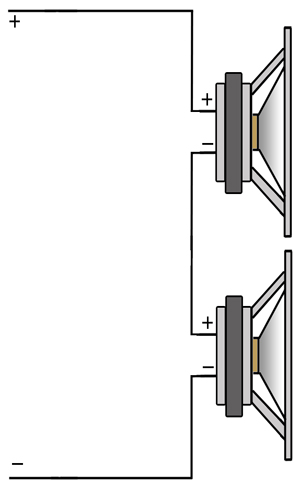
The term series where things are arranged in sequence implies how you would arrange speakers in series, as per the diagram below you can see that the positive (+) terminal of the first speaker is connected  to the positive (+) of the amplifier as normal, but the negative  (-) terminal goes the the positive terminal of the second speaker. The last speaker in the series has it’s negative (-) terminal connected to the negative (-) terminal of the amplifier.

series_web

Series impedances work opposite to parallel, going back to the comparison with traffic, if your busy road has traffic lights in it, every extra set of traffic lights adds more resistance to traffic flow. In the same way, each loudspeaker in series adds to the impedance. To calculate the total impedance, simply add together the individual impedances, as shown in the table below. In most instances, its rare to have more than 2 drivers wired in series, as the increase in impedance will mean most amplifiers are able to deliver very little power to the drivers.

No drivers Series Impedance
1 8 ohms
2 16 ohms
3 24 ohms
4 32 ohms

 If we get less power, what’s the point of connecting drivers in series?

If you just have one pair of speakers, there isn’t much point, but it gets interesting when you have multiples of speakers. If for example you have four speakers, that are 8 ohms, and you want to run all four speakers off one amplifier, you could wire all four in parallel, to give a 2 ohm load, or all 4 in series to get a 32 ohm load. But what if your amplifier wont work below 4 ohms?

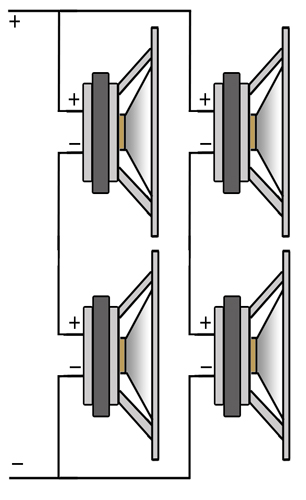
The solution is simple, a series-parallel combination:

series_parallel


Assuming all drivers are 8 ohms, some simple maths and you can see that each of the two series combinations has an impedance of 16 ohms. Two 16 ohm impedances in parallel have an overall impedance of 8 ohms. What this allows you to do is use four speakers where you would previously have only used one, giving you a significant increase in power handling.

Variations of series-parallel configurations are common in guitar speakers,  4 x10″ and 4 x 12″ cabinets are common, with different wiring to suit specific applications and impedance requirement. Many guitar cabinets utilise 16 ohm drivers in order to achieve the desired results.

Its sometimes advised that its best to avoid using series configurations with speakers, due to the fact that that you have two coils or inductors which can induce unwanted voltage and cause distortion. Series configurations are rarely used in hifi or studio systems.


1 Comment. Join the Conversation

Why does my 8 ohm speaker read 6 ohms when I measure it on a multimeter? It must be faulty right?

WRONG!

I’ve heard this so many times I’ve lost count, but there is a difference between impedance and resistance. When you measure resistance with a multimeter you are measuring DC resistance. The DC resistance is determined by the copper (or sometimes aluminium) wire in the voice coil of the speaker, and is actually as the name suggests; resistance to the passage of electric current through the copper. The key point here is that the electrical current travels in one direction only, and is fixed and does not change.

Impedance is equivalent to resistance, but for circuits where the voltage and current change, such as in a loudspeaker. An extra factor comes into play, which is the fact the the loudspeaker is based on a coil of wire. This coil of wire acts as an inductor. Without getting too involved in the science part of this, its sufficent to know the inductor creates an additional ‘reactance’ to alternating signals, which when added to the DC resistance of the voice coil, gives the overall Impedance.

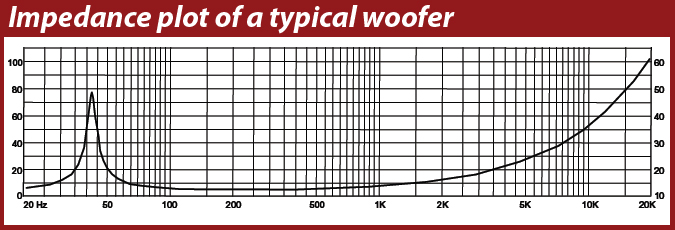
To complicate matters further, the Impedance varies with frequency, so the 8 ohms specified for loudspeakers is not totally accurate, it is referred to as ‘nominal impedance’ – a kind of ‘average’ impedance figure that can be used for typical calculations involving loudspeakers. The graph below show a typical 18″ subwoofer, the impedance is shown on the scale on the left hand side.

impedance

For purposes of being able to run your own sound system, or building your own speakers, it’s sufficient to accept the manufacturer’s quoted impedance as being correct for your application. You don’t need to be concerned with the finer points of impedance unless you get into more serious aspects of speaker design, and if you’re at that level, I highly doubt you will have bothered read this far, as you will know all of this already!


Be the first to comment

With current technology, it’s  impossible to have a single transducer that is able to reproduce the entire audio spectrum effectively, different types of loudspeaker driver are better suited to different speakers. Typically those handling lower frequencies are cone drivers, and commonly known as woofers. Drivers handling higher frequencies are usually much smaller, and are often known as tweeters. In many basic speakers its common to have a woofer and a tweeter in order to cover as wide a range of the audio spectrum as is possible.

A crossover is a device which splits sound/music into two or more frequency bands. In the case of a basic two-way system there would be two bands, one band covered by the woofer, and one by the tweeter.

Why can’t we just put a Woofer and Tweeter in parallel without a crossover?

Tweeters can not handle bass frequencies, lots of bass into a tweeter would destroy it. Tweeter must have high frequencies only, limited to the frequencies the tweeter is designed to handle.

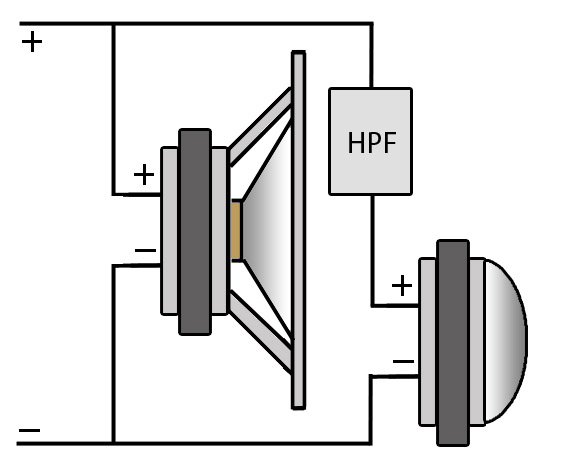
In a very simple speaker, you could just use a high pass filter in series with a tweeter, in parallel with the woofer. The high pass filter would remove damaging bass frequencies and keep the tweeter operating safely.

For purposes of simplicity, all diagrams will be simplified, and a 1st order filter is assumed to be in use. A 1st order filter does not require a connection to negative (-) and can be simply put in series as per the diagram. Any filter 2nd order or higher will require a connection to negative from the filter, which will be explained in more detail in another article: https://speakerwizard.co.uk/passive-crossoversfilters-how-do-they-work/

Simple speaker with Passive High Pass Filter in series with tweeter:

hpf_only

HPF in the diagram is the High Pass Filter, which must be fitted in series with the Tweeter in order to protect it.

For basic speaker designs, this solution may sometimes be acceptable, but you need to be aware of the fact that below the filter frequency, the impedance of the circuit will be 8 ohms, as the amplifier will only see the woofer as the load, but at high frequencies, the amplifier will deliver power to both the woofer and the tweeter, this will present a 4 ohm load to the amplifier at higher frequencies. (8 ohm impedance of woofer and tweeter assumed in this example)

If you only intend to put one cabinet on the output of the amplifier, this wont present a problem, but if you use multiple cabinets you may find the overall impedance drops too low, which is undesirable.

Many woofers are also very inefficient at reproducing high frequencies, whilst they will readily allow power from the amplifier, they wont necessarily turn that power into anything useful, in effect wasting the power from the amplifier.

The final thing to consider is that some woofers really dont sound good outside their designed operating range, so whilst putting high frequencies signals through the woofer wont damage it, the woofer may just sound completely horrible when it tries to produce those frequencies.

The Solution? 

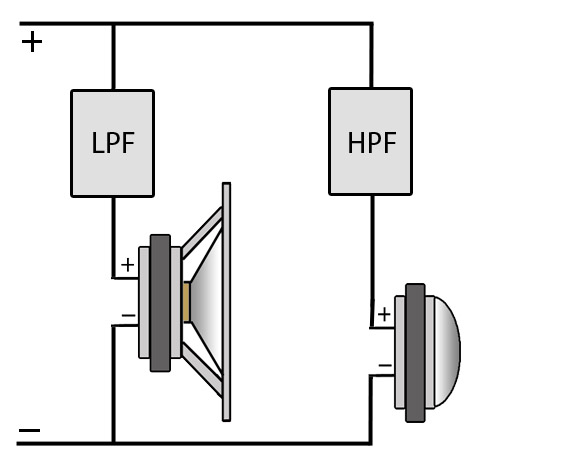
The solution is to put a Low Pass Filter (or LPF) in series with the Woofer, this filters out high frequencies, so that the woofer is only producing sounds that are in its operating range.

2-way crossover

The above diagram shows a passive LPF in series with the woofer, and a passive HPF in series with the tweeter.

A matched LPF and HPF that usually share the same cut-off frequency form a system known as a crossover. With a simple two-way system, crossover frequencies of between 1200 Hz and 3000 Hz are common, depending on the components used.

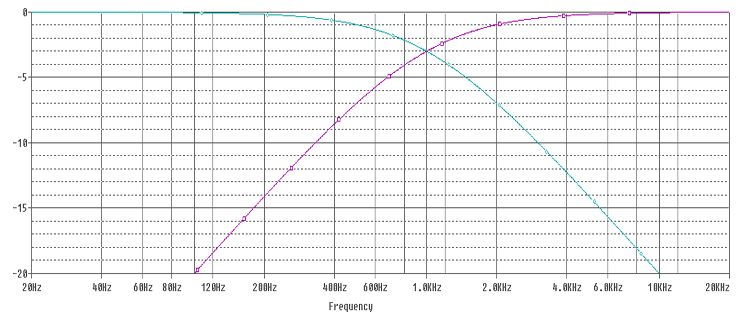
The cut off frequency is the point in the audio spectrum at which the filter begins to take significant effect, in the case of a Low Pass Filter, frequencies significantly below the cut-off frequency should be passing through unaffected. Just slightly below the cut-off frequency the filter begins to take effect, and starts blocking. The cut-off frequency is generally regarded as the point where the signal is at -3dB, and is in the middle of the ‘knee’ or bend in the response graph. Just above the cut-off frequency, the level begins to drop off rapidly, blocking higher frequency signals from passing. The HPF filter works the opposite way around.

crossover_plot_1

By aligning the cut-off frequencies to be the same on the HPF and LPF circuits, the system impedance will stay more or less the same over the audio spectrum. Overlapping the cut-off frequencies of passive filters will cause the impedance to drop in the overlapped range. Leaving a gap between the cut-off frequencies will cause the impedance to rise in the gap.

It is possible to create more elaborate passive crossovers, such as three way crossovers that split the sound into bass, mid and treble. For smaller applications, such as hifi or studio speakers this is fairly common, but this becomes less common in high power PA speakers, as the component costs can increase significantly and in some instances it becomes difficult to source parts that can handle sufficient power

So far, we have only tackled passive crossovers..

So what is an active crossover? and whats’s the difference?

Passive crossovers do not have their own power source, all they can do is block the signal, they are regarded as passive as they can not increase it or amplify it. Passive crossovers/filters are placed between the amplifier and the speaker driver(s).

Active crossovers work quite differently. DO NOT ever fit an active crossover between the amplifier and driver, they are designed to go BEFORE the amplifier.

An active crossover will split the signal at line level, before it reaches the amplifier. The amplifier will then only amplifier the desired frequency band and deliver those frequencies to the speaker. This is a better solution, as it is more efficient – any passive crossover will have losses in it due to the components used to do the filtering. The losses amount to wasted power. Also, in cheaper crossovers, distortion can be introduced from cheaper components. Low losses and minimal distortion can be achieved with passive crossovers, but the cost of components can become astronomical, making active crossovers a better solution. There are also physical limitations with what can be achieved with passive crossovers, and as the overall system power is increased, passive crossovers become a less desirable solution.

There is a significant difference with using active crossovers, you need more amplifiers.

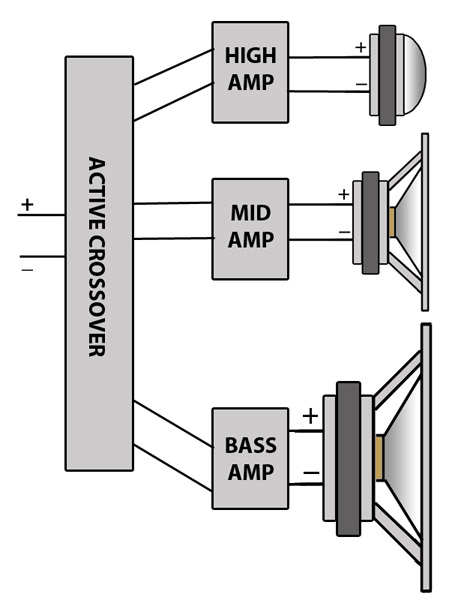
By splitting the signal BEFORE the amplifier, you then need a separate amplifier for each frequency band. In the case of a two-way system you will need two amplifiers, for a three-way system you will need three amplifiers.

Each amplifier will only be used to run speakers within a specific frequency band, as per the diagram below.

multi-way

An active crossover also gives a much greater level of control over the system, with a typical crossover allowing boost or gain of each frequency band, and adjustable crossover frequencies. Some more advanced active crossover also allow variation of filter type (Butterworth, Linkwitz-Riley, Bessel, etc) to give precise control over the system configuration.

For large HIGH POWER systems, active crossovers are the preferred solution, with a separate amplifier for each band.

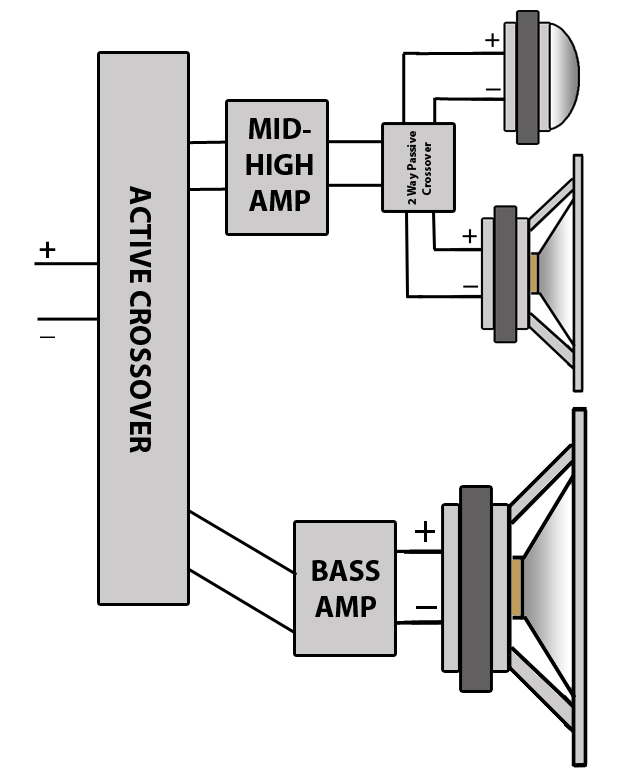
For small-medium size systems, a hybrid crossover solution is common. A 2-way active crossover is used to split bass from the mid and high frequencies, this requires one amp for Bass, and one for mid-high. The Mid-High cabinet then utilises an internal passive crossover to split between Mid and Treble. This solution is something of a compromise, it doesn’t quite give the total control of a fully active system, but it reduces the number of amplifiers needed, by not requiring a dedicated HF amplifier, and also simplifies cabling a little – eliminating the need for four core cable to run to the mid-high cabinet. This is a very common solution, as it provides a good balance of versatility and cost.

multi-way2


 Whats best active or passive?

Its generally regarded that active crossover solutions are best, for a number of reasons:

1. Passive crossovers are always lossy, even the best passive crossovers lose some power within the crossover, primarily due to the DC resistance of the inductors.

2. Sound quality. Passive crossovers using cheaper components can often suffer from sound quality issues, to achieve better sound quality costs often escalate with passive crossovers.  Generally, active crossovers offer better sound quality than passive crossovers.

3. Active crossovers allow for a more accurate predictable response, there is always some manufacturing tolerance with inductors and capacitors with variation of values of +/- 5% being common. This can often mean (more so with cheaper components) that no two passive crossovers will produce exactly the same response, so if your system comprises of numerous speakers, they could all be producing a different sound around the crossover frequency.

4. Better control. With active crossovers its much easier to balance different frequency bands. Its common with passive crossovers to require attenuation of high frequencies, through the use of attenuation resistors. With an active crossover you can just reduce the gain.

5. Easier scalability. Active crossovers make it easier to increase the size of your system, you can simply add more amplifiers and more speakers, and run them off the same signal from your crossover.


Be the first to comment

To save you time, we’ve put together a calculator for one of the most common passive crossovers, a 2nd order Butterworth. You can configure the Impedance of the woofer and tweeter, and the crossover frequency.

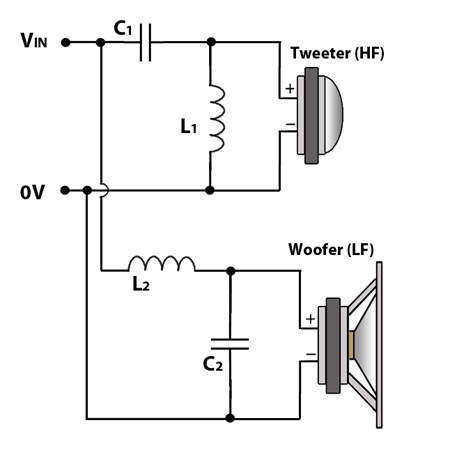
C1, C2, L1 and L2 correspond to the relavant capacitors and inductors in the diagram below:

2nd order Crossover medium

Where Vin is connected to the positive terminal of your amplifier, and 0V is the negative terminal. The dots on the circuit signify where components/wires are connected. L2 connects to the input, and NOT to 0V, hence the ‘loop’ in the wire in the diagram.


New improved version of the crossover calc this now includes a graphical plot of the frequency response. Due to the size of the graphics, the form below will submit to a full page version of the calculator. You can select 1st order or 2nd order slopes, with the option of Linkwitz-Riley on 2nd order. We will add 3rd order and 4th order in due course. This calculators works two ways, you can enter the frequencies and impedances and calculate the component values, or you can enter the component values to get the crossover frequencies and see the frequency response. This version also allows different impedance and frequency between Low Pass and High Pass, as well as different slopes. So you could for example have the Low Pass section with a 8 ohm woofer, crossing over at 1200 Hz, and the High Pass at 16 ohms crossing over at 1800 Hz. Combinations like this are becoming increasingly common, as using a 16 ohm HF driver often negates the need to put attenuation in the HF part of the circuit. Also, a typical 1600Hz Butterworth crossover can often have a peak in response around the crossover frequency, particularly if the HF driver is highly efficient – offsetting the crossover frequencies may seem counter-intuitive as it might appear you are leaving a hole in the response, but often the coupling between LF and HF counteracts this. If you already have a crossover, you can simulate the response using the lower part of the controls. Please check you have component values correct, Capacitors should be specified in microFarads (uF) and Inductors in milliHenries (mH). Most pre-built crossovers will have capacitor values printed on the components, unfortunately very few divulge the Inductor values, to get these you will need an appropriate measurement meter.

2nd order Crossover Calc
To get the component values for a crossover, enter the impedances and crossover frequencies for the high pass and low pass sections and then click ‘CALC’
LOW PASS
Low Pass Fc:
Woofer Impedance: Ohms
HIGH PASS
High Pass Fc:
Tweeter Impedance: Ohms
Plot type: POWER AMPLITUDE
To see the response and crossover frequencies for known component values, enter these in uF and mH in the boxes below and click ‘CALC’
C1: uF
L1: mH
C2: uF
L2: mH


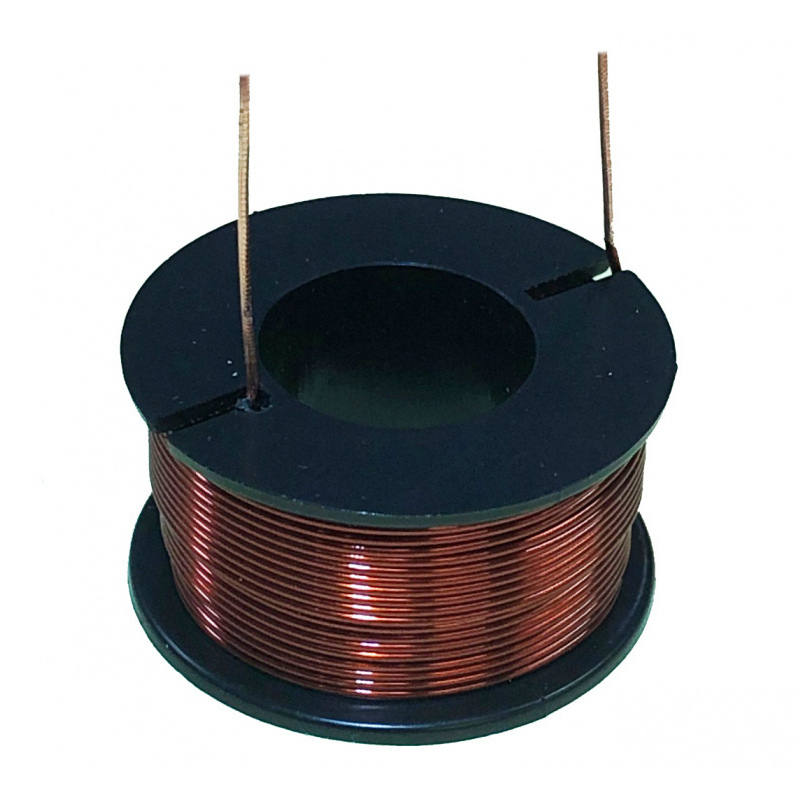
You’ve most likely seen coils of copper wire in audio filters, but what do they do? and how do they work? We’ll try to give a simple explanation here.

At the most basic level, and inductor is just a coil of wire, and the design and construction of the inductor determine it’s inductance, which is usually measured in millihenries. Larger value inductors tend to be needed for low frequency filters, perhaps as big as 4 or 5 millihenries, but much lower value inductors are needed for higher frequency audio applications, typically between 0.1mh and 1.5mH for most common 2 way crossovers.

So, how do they work? It gets a bit sciencey, so we’ll try to keep it simple. When current flows through a wire, it creates a magnetic field around the wire. When the wire is wound as an inductor, the magnetic fields from various sections of the inductor will each have an effect on other parts of the inductor, creating a electro-motive force within the wire/inductor that opposes the applied voltage to the inductor. In effect creating an electric force in the wire that’s opposite to the voltage that’s being applied. At low frequencies, the opposing force is very small, and the inductor acts just like a piece of wire. The opposing force gets bigger and bigger as the frequency goes up, and this makes it more difficult for high frequency signals to pass through the inductor. This allows a single inductor to work as a low pass filter – blocking high frequencies and letting low frequencies pass through.

All you have to do is select the correct value of inductor (in mH) for the cut-off frequency you need for your filter.

Well, if only it were that simple. You then need to decide what type of inductor to use.

Ferrite Core. For low power filters, people have often used ferrite cored inductors. The magnetic permeability of the core increases the magnetic field strength of the inductor, allowing a specified inductance to be reached with much fewer turns of wire. This has the benefit of reducing the resistance of the inductor, making it less lossy, and ensuring more of the power reaches the speaker and less is lost in the inductor as heat. Ferrite cored inductors have a problem, they will saturate at high power levels, when the maximum magnetic field strength has been reached in the core, after this the field cant continue to increase, which causes the inductance to decrease. This causes increased distortion, and is undesirable in audio circuits. Most designers avoid ferrite cored inductors for higher power circuits.

Powdered Iron Core. You could think of these as a ‘premium’ ferrite core – they have similar benefits in terms of fewer turns of wire. They offer improved power levels due to higher saturation point, but this comes at increased cost. Considered a good compromise where ferrite core is too low power, but air cored is too big and expensive.

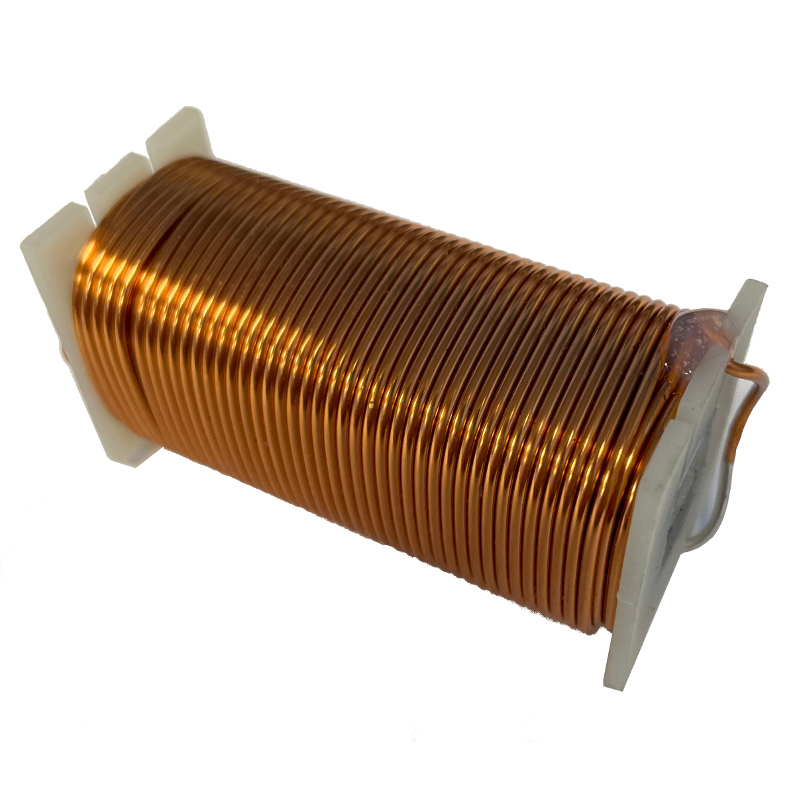
Laminated Steel Core. Another alternative to ferrite core inductors, but suffering from similar distortion issues especially at higher frequencies, which makes them more suited to low pass filters. The saturation point is lower than powdered iron core, but they benefit from the fact that large value inductors (2mH-4mH) are possible without huge amounts of wire being used, this helps keep the size and cost manageable, and avoids losses due to resistance of the wire.

2.0mH Laminated Steel Core Inductor

Shop for Laminated Steel Core inductors on www.bluearan.co.uk – the UK’s leading loudspeaker components supplier for Pro Audio

Air Core. Ask any audiophile, and just plain simple air is what’s best inside an inductor. The saturation point is typically so high you can achieve extremely high power levels without distortion from saturation. The inductor is generally unaffected by temperature changes, and the core (being air) cant rattle, vibrate or crack, and so is very stable. There is a drawback – particularly at low frequencies – in the the inductors can get quite large and expensive. The size of the inductor can mean losses in the wire, and heat build up, which are not ideal. Imagine your inductor having a resistance of 1-2 ohms when your speaker is 8 ohms – significant power loss can occur in the inductor before the power gets anywhere useful.

0.31mH Air Cored Inductor

Shop for Air Cored Inductors on www.bluearan.co.uk – the UK’s leading loudspeaker components supplier for Pro Audio

Its fairly common for manufacturers to mix different types of inductors in one filter according the required power handling, frequency, and price point. There will always be some compromises, but choosing the best in each situation gets the required result.