What Is η₀ (Eta Zero)?

η₀, also known as reference efficiency, represents how efficiently a speaker converts electrical power (watts) into acoustic power (sound energy). It is expressed as a percentage (%), indicating the fraction of input power that is actually turned into sound rather than lost as heat in the voice coil.

Most loudspeakers have relatively low efficiency, with typical values ranging from 0.1% to 10%. This means that in many cases, over 90% of the amplifier’s power is lost as heat, rather than being converted into audible sound.

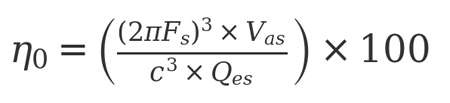
Formula for η₀ (Reference Efficiency)

The reference efficiency of a speaker is calculated using the following equation:

Where:

  • Fs = Free air resonance (Hz)
  • Vas = Equivalent compliance volume (m³)
  • Qes = Electrical quality factor (unitless)
  • c = Speed of sound (343 m/s)

This formula shows that higher efficiency is achieved when a speaker has:
A lower Qes (stronger motor control)
A larger Vas (more compliant suspension)
A higher Fs (higher resonant frequency)

Speakers with low Qes and high Vas tend to be more efficient, while those with high Qes and small Vas are generally less efficient. A higher η₀ means better efficiency, but this is influenced by trade-offs between motor strength (BL), moving mass (Mms), and suspension compliance (Cms).

Real-World η₀ Ranges for PA Speakers

PA drivers do not typically reach the 5-10% efficiency figures sometimes quoted, whilst historically some higher efficiency woofers were manufactured, they typically had very low power handling, very lightweight cones, and low excursion capability , which made them suitable for limited applications and required extreme care when they were used.

η₀ (Efficiency)Performance CategoryTypical Applications
4%+Very highHigh-efficiency drivers, usually mid-range
3% – 4%High efficiencyHigh-performance PA bass drivers
2% – 3%Good efficiencyGood quality PA woofers
1.5% – 2%Average efficiencyGeneral purpose PA drivers
0.75% – 1.5%Low efficiencyBudget applications, or optimization for low Fs
Below 0.75%Very low efficiencyOften optimized for very low Fs

🔹 Compression drivers and horn-loaded midrange drivers often exceed these values due to acoustic loading.
🔹 Large subwoofers with very low Fs tend to have low η₀, as their design prioritizes deep bass over efficiency.

η₀ vs. SPL – How Are They Related?

While η₀ tells us how much input power is converted into sound, sensitivity (SPL @ 1W/1m) is often a more practical measurement:

A higher η₀ typically results in higher SPL, meaning the speaker requires less amplifier power to reach the same volume. This does depend on cabinet design, frequency range and application. A well optimised infra-sub may well have efficiency lower than 1%, but at 30 Hz could outperform a general purpose woofer designed for kick-bass. The infra-sub would be sloppy, slow and inefficient around 100Hz, compared with the kick-bass driver which would be fast, precise and most likely 5 times louder.


Nominal impedance (Z) is the simplified, rounded value used to describe a speaker’s average impedance across its frequency range. Unlike DC resistance (Re), which is a fixed value, impedance varies with frequency, often rising at resonance and at higher frequencies due to voice coil inductance (Le).

Because impedance isn’t constant, manufacturers round it to standard values—typically 4Ω, 8Ω, or 16Ω—to make system design easier.

Why Standard Impedance Values?

The reason we commonly see 4Ω, 8Ω, and 16Ω speakers is simple: compatibility and ease of wiring. These values allow multiple drivers to be connected in series or parallel without creating unpredictable impedance loads that could damage amplifiers.

  • 4Ω speakers are common in car audio and some PA systems, as they draw more power from an amplifier.
  • 8Ω speakers are standard in home and PA systems, allowing for flexible wiring.
  • 16Ω speakers are often used in guitar cabinets and some PA setups, where multiple drivers are wired together.

Most amplifiers are designed to handle specific impedance loads, so using standard values ensures predictable performance and prevents excessive current draw or amplifier overheating.

Nominal impedance is not a fixed number but a rounded-off guideline to help with speaker and amplifier matching. Understanding this helps ensure proper wiring, optimal power transfer, and amplifier protection in PA systems, home audio, and car audio setups. Your amplifier may specify a power output into 8 ohms, but your woofer may actually have an average of around 7-7.5 ohms at the frequencies you are using it, this could result in the power to your speaker being slightly higher than anticipated, so it’s important to remember these are GUIDELINE figures only.


Driver TS Parameters: Xmax

Posted By Andy Kos

Possibly one of the most misunderstood parameters, most people know Xmax concerns driver excursion, but dont really know  precisely what it means, and it is probably the name that confuses people, as it is slightly misleading.

We’re used to  letters X and Y denoting dimensions, and in this case, X does relate to a dimension, it’s to do with the distance a loudspeaker’s voice coil travels back and forth, so it’s all good so far – but the ‘max’ is what throws people. Its natural to assume max means maximum, and the conclusion most people reach is that X max means maximum excursion in dimension X, which is nearly right. What’s missing is the word linear. Xmax is generally regarded as maximum linear excursion – but what exactly does that mean?

Let’s look at a simplistic way of how Xmax is often calculated (this applies to overhung voice coils – which is most common in high power loudspeakers)

The Formula is: (HVC – HG) / 2

Where HVC is the Height of the Voice Coil, and  HG is the Height of the magnetic Gap.

To understand this we need to look at how the components of a loudspeaker fit together, this is a simplified cross-sectional diagram of a common loudspeaker.
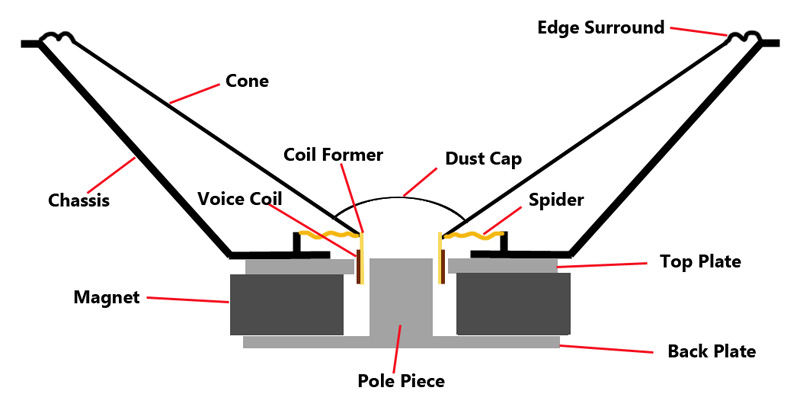
 

Cross-sectional diagram of a typical loudspealer

Cross-sectional diagram of a typical loudspealer


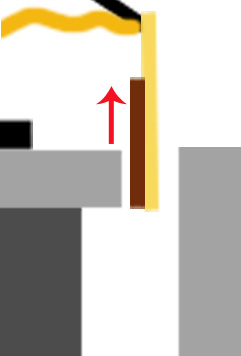
Now, let’s look in more detail at the area around the voice coil, we’ve removed the right hand part of the voice coil to make the diagram clearer.
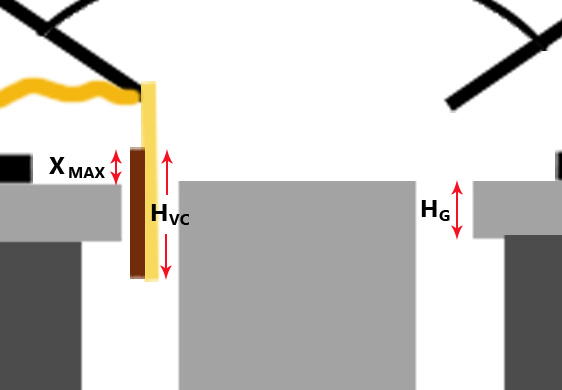
 

Voice coil in magnetic field, showing Xmax and Magnetic Gap Height

Voice coil in magnetic field, showing Xmax and Magnetic Gap Height


You can probably now see why Xmax is often referred to as Voice Coil Overhang. It’s the amount by which the voice coil overhangs the magnetic gap, but why is this significant?

Let’s take a closer look at the static magnetic fields in a loudspeaker. These are the fields generated by the magnet, rather than the fields generated by the voice coil.
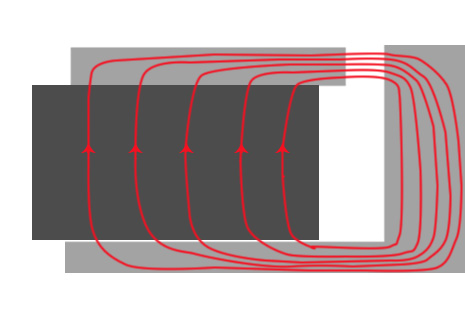
Magnet structure and magnetic flux (simplified)

Magnet structure and magnetic flux (simplified)

This is a simplified diagram, intended to show the most significant path of magnetic flux. There will also be stray flux outside the speaker, and inside the air gap between the magnet and pole piece, and in a real speaker, the field lines are unlikely to quite as uniform as in the above diagram, but it should be sufficient to see the general principle of how the magnetic field is acting.  The permanent magnet has a north pole at one end, and a south pole at the other. Depending on the speaker manufacturer, it’s normal for the pole piece to become the ‘north pole’ and the top plate to become the south pole. The shape of the top plate, and pole piece helps focus the magnetic flux, and you will notice the lines of flux are closest together in the magnetic gap – where the voice coil would normally be.

Since ferrous materials are much more magnetically permeable than air, by a factor of about 400.  Magnetic flux will tend to take the route of least resistance, in much the same way as electricity does, this will mean the magnetix flux  will tend to want to travel through the metal parts of the speaker. Where it reaches the gap it will continue to go down the route of least resistance, which in this case will be the shortest distance through the air, ie straight across the gap. The flux is squeezed together across the gap, causing the flux to flow in parallel lines across the gap, creating a uniform, linear magnetic field.

Traditionally Xmax was calculated mathematically using the simplistic formula mentioned earlier, this is because many earlier speaker designs used relatively weak magnets, and it was assumed that the magnetic field would drop off very significantly just above or just below the gap, and would be of little or no use.

When you pass electrical current through the voice coil, it will create its own electromagnetic field, which will push against the magnetic flux in the voice coil gap, causing the voice coil to move. If you keep driver excursion within Xmax, there will always be the same height of voice coil within the gap. The diagrams below show the maximum excursion in each direction to keep within mathematically calculated Xmax. Since the magnetic field in the gap should be linear and uniform, and the height of voice coil within the gap remaining constant, mathematical models can be created to predict driver behaviour. Working outside Xmax will cause those mathematical models to become inaccurate, as well as potentially introducing distortion and other poor performance.
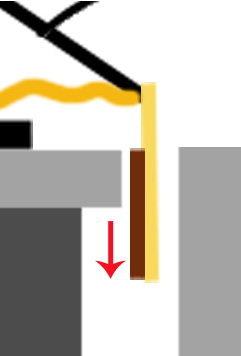
 

Maximum back excursion

Maximum back excursion

Maximum forward Excursion

Maximum forward Excursion


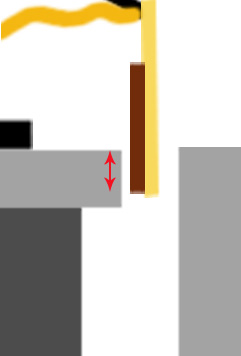
Moving the voice coil  any further up or down in either direction, as in the diagrams below, would cause the height of the voice coil that is within the magnetic gap to become shorter, shown by the red arrows.  You can clearly see this is less than the Gap Height. Less Voice Coil in the magnetic gap, means less pushing force moving the cone, which is where the non-linear behaviour starts, hence the term maximum linear excursion. The cone will still move, but it will no longer be optimal performance.
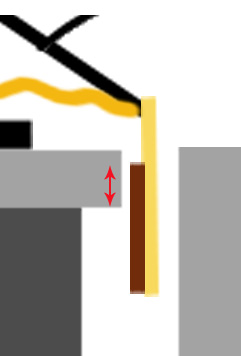
 

Xmax exceeded

Xmax exceeded

Xmax exceeded

Xmax exceeded


It is becoming increasingly common to use stronger magnets in modern designs, which can sometimes mean that useful magnetic flux (although slightly weaker) will also be present just outside the gap, and magnetic field strength may still be acceptable in this area. Depending on the magnet strength, and other factors,  Xmax  when consider to be a measure of maximum linear excursion can actually be 25%-40% larger than mathematically calculated Voice Coil Overhang.

So when you are comparing one brand of driver to another, you need to be aware that the Xmax figures may be calculated differently, and a driver with a specified Xmax of 7mm from one manufacturer (using Voice Coil Overhang) could in fact have a very similar performance to one from another manufacturer with an Xmax of 10mm, who has perhaps used a different mathematical model and/or tolerance to determine the limit of linear excursion.

The best solution may be to determine Xmax by measurement rather than simple maths, and there is a growing trend towards using Klippel Analysis to determine Xmax more accurately, the driver is progressively driven to high levels at low frequencies, and Xmax is determined by measuring excursion at a level where 10% THD is measure in the output. This is believed to better represent actual driver performance, however is quite time consuming, and can be difficult to measure, consequently many manufacturers do not bother.


What is the significance of Xmax?

Cone excursion is related to loudness, especially with deep bass frequencies in a bass reflex cabinets. To reproduce bass frequencies at high volume you need to move a lot of air, and to move that air your speaker cone needs to move a lot. A bass driver with a low Xmax will generally not be designed to reproduce bass frequencies at high power, as it simply can not move enough to do the job. There is an exception to this in horn loaded bass cabinets, where excursion can be restricted, and Xmax may be less critical, depending on the design.

Will exceeding Xmax damage the speaker?

Not necessarily, some manufacturers will also specify Xlim or Xdamage which is the maximum mechanical excursion before damage is expected, this can often be double Xmax. The two will often be related, a driver with a large Xmax designed for long excursion, will usually be designed such that Xlim is proportional to Xmax. Xlim is often regarded as maximum mechanical excursion, as this is the point where you will cause mechanical damage if you exceed this, most commonly with the end of the voice coil hitting the back of the speaker and damaging the voice coil former:

Exceeding Xmax

You can in most instances exceed Xmax without causing mechanical damage to the voice coil, however you should take note that exceeding Xmax can reduce the power handling due to detrimental effects on voice coil cooling.

Depending on the driver design, other things to consider when exceeding Xmax is the mechanical stresses on the speaker components, such as the spider, and where the spider joins the cone and coil former. There is potentially a large force acting on these components, stretching and pulling them beyond their designed limits. Whilst you can often exceed design parameters a little without causing damage, it would not be a sensible idea to exceed Xmax significantly as you will reduce the useful working life of your speaker.



Qes – Electrical Quality Factor

Qes represents the electrical damping of a driver at its resonant frequency (Fs). It describes how efficiently the voice coil and magnet system control cone movement, with lower values indicating stronger motor control and higher values indicating weaker electrical damping.

How Qes Affects Speaker Performance

  • Low Qes (< 0.3) → Strong motor, tight control, high efficiency. Ideal for horn-loaded and high-SPL designs. The motor force is high, sufficient to overcome resistance from air inside the cabinet..
  • Medium Qes (0.3 – 0.6) → Balanced damping, suitable for bass reflex (ported) enclosures.
  • High Qes (> 0.6) → When the motor force is lower, the driver depends more on its suspension (spider & surround) to return the cone to its neutral position. In a small cabinet, the trapped air acts like an additional spring, increasing resistance to cone movement. A larger cabinet provides less air resistance, allowing the cone to move more freely and extend bass response.

Qes and Its Relationship to Other T/S Parameters

Qes is directly linked to several key Thiele-Small parameters:

  • Qts (Total Quality Factor) is calculated from Qes and Qms (mechanical damping)
  • Efficiency (η₀) is influenced by Qes—lower Qes generally leads to higher efficiency.
  • Enclosure Suitability: A high Qes driver may work better in large cabinets, while a low Qes driver is usually more efficient and can be used in compact, high-output designs.


Efficiency Bandwidth Product (EBP) is a useful guideline to determine whether a speaker driver is better suited for a sealed, ported (bass reflex), or even horn-loaded enclosure. It provides a quick way to assess how the balance between resonant frequency (Fs) and electrical damping (Qes) influences enclosure suitability.

How to Calculate EBP

Where:

  • Fs = Free-air resonance (Hz)
  • Qes = Electrical quality factor (unitless)

A higher EBP indicates a more efficient driver with lower electrical damping, making it better suited for ported or horn-loaded designs. A lower EBP suggests that the driver has higher electrical damping, which typically works better in sealed enclosures. Below we have listed typical applications for 18″ woofers according to their EBP. As woofers get smaller (12″) it becomes possible to have unusually high EBP which may not fit into these broad guidelines.

🔹 Sealed Enclosures (EBP < 50)

  • Drivers with lower Fs and higher Qes tend to work best in sealed cabinets.
  • The air inside the box acts as a restoring force, helping to control cone motion.
  • Sealed boxes produce tight, accurate bass, but efficiency is lower. Usually also the bass extension is restricted

🔹 Ported Designs (EBP 50 – 100)

  • Some drivers can work in both sealed and ported enclosures, depending on tuning.
  • If EBP is closer to 50, it may lean towards sealed.
  • If EBP is closer to 100, it will usually perform better ported.

🔹 Ported and Horn Loaded Designs (EBP 100-120)

  • Some drivers can work in both ported enclosures and horn loaded designs
  • High EBP usually allows for a compact bass reflex design.
  • Most Horn Loaded Designs require high EBP woofers, but design adjustments can compensate for lower EBP.

🔹 Horn Loaded Designs (EBP 120+)

  • Some high EBP woofer will work in bass reflex designs with VERY carefully made design adjustments
  • High EBP usually means high efficiency in a horn loaded design
  • Some Horn Loaded Designs with VERY high EBP woofers will be extremely efficient, but sound unnatural.

The guidelines above are intended for PA applications where maximising efficiency is the primary objective. In hi-fi applications, it is often possible to do things ‘outside of the box’ such as using a low EBP woofer in a horn, not because its efficient and loud, but because it sounds ‘nice’. This wouldn’t be appropriate in a PA application, as its very likely that you could damage the speaker when trying to operate it at high volumes.


Thiele Small Parameters

Posted By Andy Kos

The Thiele Small Parameters (often referred to as T/S Parameters) are provided in specification sheets by most manufacturers – but what are they for? A more detailed explanation of each parameter is provided in the relevant sections, but in simple terms, these parameters define the electromechanical properties of a loudspeaker driver, describing its electrical and mechanical behavior.

Once you understand some of the basics of the Thiele Small parameters, you will know what to look for when it comes to choosing a loudspeaker driver. If you’re not interested in the finer details, it’s enough to know that these parameters are mainly used for simulating loudspeaker behavior to optimize cabinet design. For those keen to learn more about these parameters, this section should cover almost everything you need to know.

The following small signal mechanical parameters describe a driver’s behaviour at low power levels

Since these characteristics are difficult to measure directly, it is often easier to derive missing parameters from other measured values. Other parameters, known as small signal parameters, are as follows:

Large signal parameters, listed below, are used when predicting driver behaviour at high power levels:

Other commonly used parameters:

  • EBP (Efficiency Bandwidth Product) – Fs / Qes useful to determine optimal enclosure type
  • SPL – Sensitivity at 1W/1m (dB)
   

Re is the DC resistance of the loudspeaker’s voice coil, you should not confuse this with impedance, although related, the two are different.

Measuring the resistance of a speaker with a multi-meter, the reading you get across the terminals should be close to the manufacturer’s specified Re, it’s not unusual to get a minor variation from manufacturer’s published specifications, chances are the Voice Coil resistance will actually be correct and your multi-meter is what’s wrong.

So why is Re around 5-6 ohms, but the impedance specified as 8 ohms. Let’s look at what Re actually signifies, it’s the DC resistance of the wire in the voice coil. If you were to unwind your voice coil, and run it out in a straight line, connect it to a battery or other power source you could predict the current through the wire using ohm’s law: V = IR, and this resistance would be an accurate measure of how much the wire resists the flow of DC electrical current through it.

All good so far, but when you wind copper into a voice coil, you create an inductor. An inductor will still behave like a straight wire when it comes to DC, (Direct Current) however, inductors behave differently when subjected to AC (Alternating current) signals. The output from your amplifier is an AC signal, as it alternates in polarity and varies in amplitude. Inductors resist change in current, when you apply an AC signal to an inductor it will create a back EMF to try to resist  the change of current, creating additional ‘reactance’, when you add the reactance to the resistance, you get the driver’s impedance. If you want a simple analogy for an inductor, you could compare it to the suspension of a car, putting weight in a car will make the shock absorbers compress a little, they resist the change, but then remain static doing nothing this would be like applying a DC signal to an inductor, it resists the initial flow of DC current, but once current is flowing the inductor does nothing. If you then drive over lots of bumps, the suspension works by creating a force that pushes back to resist all the little bumps, preventing the force of the bumps reaching the car body, in much the same way that an inductor blocks high frequency signals by creating a back EMF.

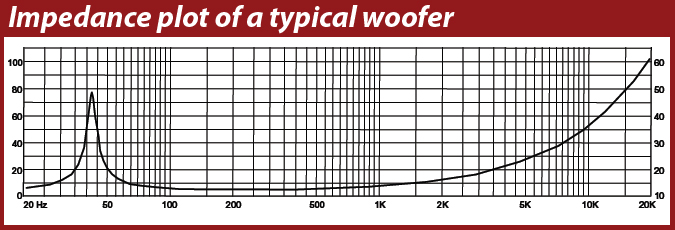
One thing to note, is that the reactive component from the voice coil can vary significantly, up to 200 ohms in extreme cases, there is a peak around the drivers resonant frequency, and then there is a increase at the upper end of the driver’s operating range. Typical impedance plot of a bass speaker:

impedance


The rising impedance from 1 kHz upwards is caused by the loudspeaker’s inductance. You can see from the above impedance curve that an amplifier will see a higher impedance of nearly 25 ohms at 5 kHz, which would significantly reduce the power that can be delivered to the speaker at those frequencies. To get better high frequency response, the inductance needs to be kept as low as possible by adjusting the voice coil geometry. In some cases this is not possible, so to improve high frequency response a common feature is to include a copper shorting ring in the pole piece of the speaker, this creates a short circuit for induced back EMF, reducing the impedance at higher frequencies and extending the mid-range response. You wont find copper shorting rings in drivers designed for sub-bass or bass applications, as it’s not needed, and they are most often found in higher quality drivers designed for better, smoother high frequency response. Used correctly, the shorting ring can extend higher frequency response by a few kHz.

In the above graph there is also a large peak just above 40Hz, this corresponds to the driver’s resonant frequency. The resonant frequency is the point that the driver will naturally move the most, where the compliance of the suspension and spider for the given moving mass are most susceptible to oscillate. The peak in impedance is caused by the back-emf of the moving coil. The more the cone moves, the greater the back-emf. Since the cone moves most at the resonant frequency, this is where the back-emf will be greatest. An impedance of 40 ohms or more will significantly reduce the power delivered to the speaker by the amplifier at those frequencies, but at the same time the speaker will naturally want to move more easily at the resonant frequency, requiring a little less power to achieve a given excursion.  You’ll notice also that the mid-band frequencies show a relatively flat response in impedance, this is where the excursion of the speaker is low, and the impedance will most closely match the ‘nominal impedance’ of 8 ohms.

The 8 ohm rating given to loudspeakers is the average impedance across the drivers main operating range. It’s useful for approximate power calculations and simpler designs, however for more advanced designs it is often desirable to measure the exact impedance at particular frequencies so that variations can be compensated for at the design stage.

Re is used in conjunction with Le (inductance) for purposes of simulating driver performance.